
A Writer's Recovery
When a literal smack in the face knocks your writing off track, how do you get back on the rails? In the hope it might be helpful to you, here is what I've learned.

Everyone has a plan until they get punched in the face, right? In the past three months I have learned how true that is for a writer. I was quite literally hit in the face, and I lost the ability to write.
Overcoming Inertia
I launched this Substack last October, at the same time as my author website. Like many substackers, I am writing my debut novel, and I wanted a place to talk to friends who may some day like join me in the alt-history Tudor kingdom of the Demon King.
But I procrastinated and I fretted. I rewrote the About Me section at least eight times (and I’m still not happy with it). But no first post would come.
Then my beloved spaniel Panda passed, and I needed somewhere to give voice to my grief. There was my Substack, a quill resting beside blank digital parchment. I fell upon it and vented my sadness into what might be the strangest first post you’re likely to read.
The relief of posting that first content was indescribable. I was hooked on the flush of fulfilment I felt at sharing Panda’s eulogy with an infinitesimal subset of the internet, and the posts began to flow every week.
I thought the next frontier was integrating my new discipline with a sustainable novel writing regimen. But events had other ideas.
The Accident
Over Christmas I suffered what in the grand scheme of things was a pretty minor training accident. I knocked out a couple of teeth. The ambulance driver literally turned to the paramedic, nudged her in the ribs and said:
“Eh! eh! All I Want for Christmas Is My Two Front Teeth!”
I tried to smile. Which of course made me look even more ridiculous.
A day in hospital and six stitches in my lip later, I was back home. But I had no idea of the impact this injury would have on my writing.
For the next ten weeks, I was in and out of dentists having minor procedures which came to a partial conclusion just the other day. And in that time I barely wrote one creative word.
It was my friend and mentor Nicholas Kotar who helped me figure out what was going on. Until then, my attempted solution was to force myself to sit down and smash through the block by sheer effort of will.
This was never going to work, and thankfully Nicholas intervened before I lost too much time to doomed wrestling matches with my willpower. I am hoping I can save others similar wasted energy.
I learned that when recovering from an injury, the survival mode locks down hard. My lizard brain was freaking out and there was no way it was going to let my creative brain take over the controls. Yes, I see my brain like the Inside Out console.
I was able to keep the show on the road: work, family life, hobbies etc. But I simply could not create. It’s not as if I would stare at a blank page in frozen horror, I didn’t have the focus to manifest frozen horror. I would use my writing time for every critical-brain distraction I could find because my creative brain was utterly silent.
The Fix
The solution came in three steps.
Healing
I had to give myself time to get better. I was anxious over repeated dental appointments, with no sense of when it would all be over and what procedure might be required at the next, as they slowly put my gum back together. I was self-conscious over the absurd gap in my teeth that made me look like a cartoon gold prospector.
Your face is your passport to the world; when the picture changes it can feel like your very identity has changed too. Just allowing myself to accept that helped me stop blaming myself for the somnolence of my creative brain.
My final major appointment was on Ash Wednesday, a perfect moment to move from survival to healing. I realised it wasn’t just my creativity that had become swamped by the physical urgency of recovery, it was my spiritual life.
Something working with Nicholas has helped me realise, underlined by my time on the 2024-25 St. Basil Writers' Workshop, is the unbreakable bond between the life of the soul and the life of the creative brain. I was still attending Mass and praying with my family, but the primacy of the physical was keeping my faith somewhat dry and mechanical. If I wanted to write, I needed to pray. Which leads us to…
Routine
I was trying to jam writing wherever I could and trusting to hope that the time would not be disturbed. But with a left brain frantic with nervous energy and a right brain cowering in the corner, there was no way I was going to be able to switch on creativity simply because I had circled a hopeful half an hour in my day and called it writing time.
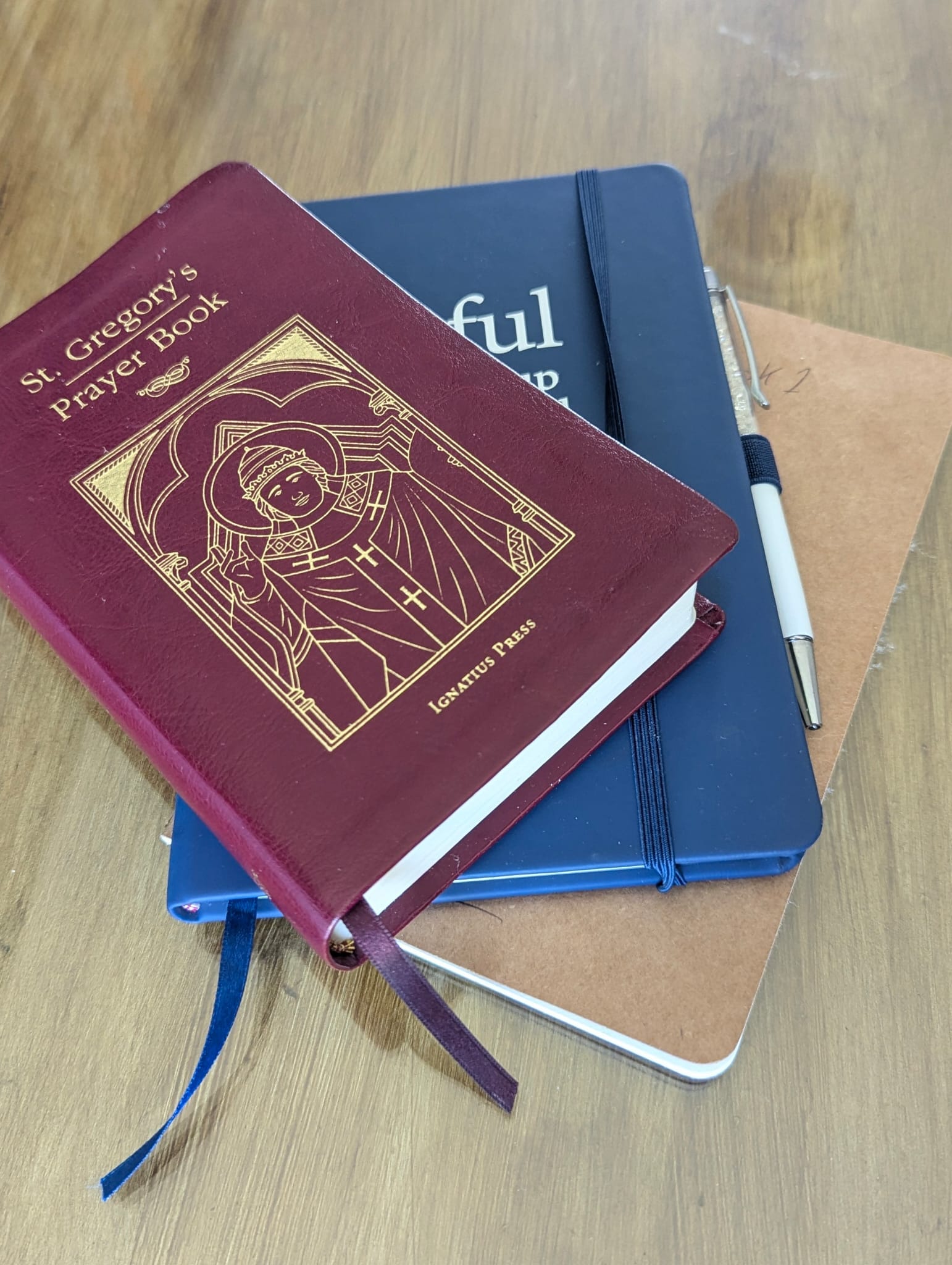
I needed a plan. I started to get out of bed 45-60 minutes earlier, and a routine began to emerge. First, a big glass of water. Then, movement; gentle mobility for 10-15 minutes to shake off the rust of sleep. Next, Morning Prayer, read from my St Gregory’s Prayer Book and following its beautiful Coverdale’s Psalter.
Only then, mind and body and soul all quieted, do I turn to writing. HOWEVER, I do not pick up the laptop.
Journalling
We arrive at the secret weapon. My Army of the Dead. My Grawp in the Forbidden Forest. Journalling.
This seemed a bit mad when Nicholas suggested it. I have limited time, surely it should ALL go into Substacking and novel writing. Yet scribbling 2 or 3 pages in a journal with an actual real life pen, before attempting anything productive, is pure magic.
Think of it like mobility for your brain. You can feel the synapses start to warm, the gentle sparking of pathways glowing into well-lit roads down which your thoughts can travel in safety from the corners of your mind out into the world.
I write about the previous day. How I’m feeling. I write about thoughts for future posts or chapters. I asterisk anything that might be a real idea worth sharing with my readers, but I don’t worry if nothing useful comes. I experiment with dreadfully overwrought descriptions of what I can see and hear around me. It doesn’t matter, if there’s no asterisk then no one, not even me, will ever read it again.
The effect on my wellbeing, let alone my ability to create, has been seismic. I commend the habit to anyone.
Words are happening
And so the anxieties and fright that caused my left-brain to stuff my right-brain into a locker have slowly exorcised themselves onto the pages of my notepad, and the small amount of productive writing time that follows each period of journalling is largely filled with contentment and creativity.
I say largely, because there are still ups and downs. But the downs are nearly always the days on which the routine and the journalling have been derailed by events or poor timekeeping.
I suspect many of us are recovering from something, carrying some burden that’s keeping our critical brain gripping white knuckled to the console whilst our creativity quietly begs a moment at the controls. Turns out, we need to create space rather than wrestle with self-control. For me, that space began with a prayer book, a notepad and a pen.
Have you ever found yourself unable to create? What helped you through it?
I can’t speak about creativity, as my limited talents in that sphere have almost totally dried up.
My upper front teeth are crowns, and I can remember that having them fitted (with the root canal, and grinding down of my remaining tooth stumps) was one of the most ritually upsetting medical procedures that I’ve had. Even more so than any other dental work, because of the location; for some reason it’s very intimate and invasive being there in the front of your mouth. Plus, as you say, being part of one’s visible face, you have the added anxiety of “what if this goes wrong” in how you actually look. This is all on top of the physical pain.
All the extra cortisol from this stress puts you in “fight or flight” mode, so no wonder you couldn’t do much at the time.
Others are better placed to say how to get your mojo back (which you appear to be, already). I just wanted to say, don’t give yourself a hard time, and don’t worry - what you went through is so much more than most people would realise: it’s not just the physical trauma, it’s the emotional, too.
Oh what’s that prayer book like?